

Upon hearing that ShiftKey and the Dalhousie Women in Tech Society (WiTS) were partnering to host a hackathon for women and non-binary students, Maggie Brown jumped at the opportunity to create it. ShiftKey and Dalhousie’s Faculty of Computer Science have supported women and nonbinary people through events and by fostering Women in Tech Society. However, an hackathon like this had not happened before.
“All we had was an amazing idea and a very powerful problem to solve,” says the ShiftKey Ambassador.
Together with Morgane Evans, ShiftKey’s Event and Communications Coordinator, and Retaj Shakir, the Events and Social Representative for WiTS, Brown developed a hackathon that addressed real-world issues women and non-binary people experience.
Once Brown created the problem statement: “How can technology, community-building, and creative solutions be used to break down social and systemic barriers faced by women and non-binary people in their fields?,” everything soon came together.
The team named the hackathon the ShiftKey x WiTS: Breaking Barriers Hackathon, and they built an event that was not only a competition but a safe space for women and non-binary students in technology. It was Brown’s first time creating a hackathon from scratch, and not only was she excited, but she also took it as an opportunity to learn about event management.
“I learned so much. This was one of my first projects from start to finish at ShiftKey, and definitely the process of planning, event planning, and execution were skills that I thought that I had, but did not have to the extent I do after that experience. And I’m very grateful for that,” she says.
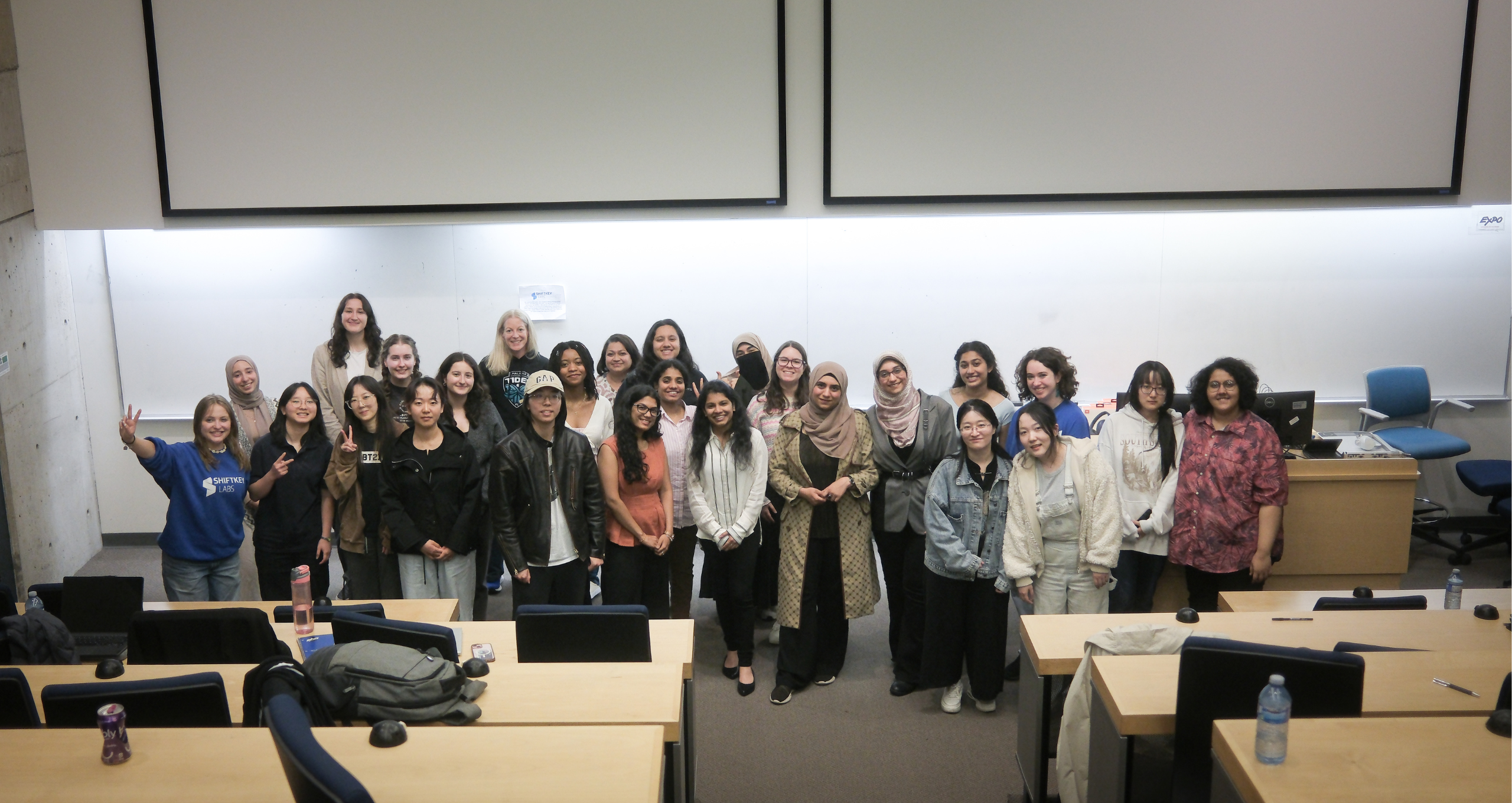
During the hackathon, which took place at the Goldberg Computer Science Building on June 27th and 28th, students who identify as women or non-binary gathered together to compete.
Although the number of participants was small, they quickly divided up into five groups, with some working individually. The excitement was obvious. Students were grateful for being in a safe space to work on projects without the stigma surrounding women and non-binary people in STEM.
One of those participants was Dalhousie Master’s of Computer Science student, Yuhan Fu, who joined the hackathon because of her love of creating projects.
“A hackathon is one of the fastest ways to go from 0 to 1, and I really enjoy the crazy brainstorming and fast-paced demo building. It’s also a great opportunity to learn new tools, pick up new skills, and push myself creatively,” she describes.
To prepare for the event, Fu worked with Brown’s published statements to create ideas about what topics she could explore. “Once I started [preparing], I quickly figured out the core idea based on the theme and my skillset. I also used ChatGPT to help draft a simple PRD, then set a few milestones to manage my time and keep things on track.”
Throughout the weekend, Fu worked alone to develop her solution: an app she named Heard. Inspired by matriarchal herds in the wild, Fu developed the app in response to the lack of support that women have in unsafe situations, particularly if they are facing domestic violence.
Through Heard, women can connect with AI-powered resources, such as emergency alert systems and contact routing, to access the safety and care they need.
Although she worked hard, winning first place was surprising.
“This was my first time finishing a hackathon solo, and also my first time winning first place,” she says. When I did my first hackathon back in January, I couldn’t even get a webpage to load properly. Since then, I’ve learned so much through each experience, and seeing that progress really made me proud of myself.”
For student Faculty of Computer Science Ambassador, Shruti Chaturvedi, who assisted with the event’s organization, seeing students like Fu create applications to address inequalities in tech was extremely impactful.
“Some of the concepts shared were incredibly creative and bold, ideas I haven’t seen at other hackathons I’ve attended or supported. It was a clear reminder of the innovation and potential women bring when they feel supported and heard,” she explains.
Many projects resonated with the event committee. Second place winner, alum Madhuri Yeluri, created an emergency contact application that those with postpartum illnesses can use to receive quick support. During her presentation, Yeluri described her postpartum complications after the birth of her second child. Yeluri’s presentation and project struck deeply with Retaj Shakir, whose relatives faced similar challenges.
“Watching her channel that pain into something that could genuinely save lives was beyond inspiring. It reminded me that technology, at its best, is a tool for healing,” Shakir remembers.
For Vishwa Patel, a Computer Science graduate and one of the judges, the participants’ projects opened her eyes to how tech can address rarely talked about gender inequalities
“There were plenty of ideas about the workplace harassment, and things that, like, I wouldn’t even think that tech could solve. But people did think about it and they presented good solutions,” she recalls.
Nupur Gaikwad, another Computer Science graduate-turned judge, was also inspired by the participants. “Their passion, innovation, and problem-solving approaches were truly inspiring and a reminder of the incredible potential that hackathons bring out in individuals and teams alike,” she says.
She also hopes that participants keep perfecting their projects and collaborate with their audiences to create long-term, ethical, and worthwhile tech solutions.
“Even after an application is launched, it undergoes continuous iterations and updates based on user feedback,” Gaikwad explains. “That’s why it’s essential for every student or developer to remain open-minded and willing to listen to constructive feedback. Such input can be invaluable in refining their proposals and ultimately building better, more effective solutions.”
While watching others find support and inspiration during the event, Brown realized how crucial the event was in creating an environment where women and non-binary students could excel.
“Seeing how much it meant to every single person there, every attendee was so excited. Not just about the problem statement, but about having a place to excel and embrace computer science culture without the negatives,” she says.
The tech industry is changing, and even recently, womenand non-binary students have felt ostracized by their male peers. Knowing that many people in her life have had this experience, Brown feels driven to create more opportunities for women and non-binary students in tech.
“[I hope] incoming students will never even have to experience anything like that. The idea that incoming students won’t even think that being a woman in computer science is a big deal is crazy. I mean, that sounds like a negative, but that’s the end goal in a way,” she says.
Having women and nonbinary students a space to address the barriers they face is just one step further towards equity. Although the projects created during the hackathon will not completely solve inequalities in tech, both Brown and WiTS founder, Professor Dr. Nur Zincir-Heywood, hope the experiences the students had will solidify that they belong in the industry.
“There are no quick solutions to address these barriers, however, there is a critical mass coming together to work together and to support each other. This tells me we are that much closer in our journey of equity, diversity, and inclusion. Just remember that we are all visible, we are all heard, and we are all together supporting each other,” Zincir-Heywood, who was also the hackathon keynote speaker, said.
Addressing the students directly, Brown wants them to understand that they are not alone and that ShiftKey will continue to host inclusive events for all women and non-binary tech students in the province.
“There are others like you, and you are not alone, although it can definitely feel like that in this crazy tech world. Especially as women and non-binary people,” Brown says. “There’s a supportive community that wants to be there for you.”
*Correction: an earlier version stated that Yeluri won third place and was a student. She won second place and is an alum.